Officers spent 40% of every permit task just searching, not acting.
Filter architecture redesign for the Business Permit Portal, shipped in five weeks ahead of a live client demo.
- Client
- City of Norwalk, California
- Role
- Product DesignerResearch, IA, UI, design system
- Team
- 1 PM · 3 Engineers · 1 Graphic Designer · 1 Product Designer
- Timeline
- Jul – Aug 2025 · 5 weeksFixed conference demo date + live client review
01 · Context & Reframe
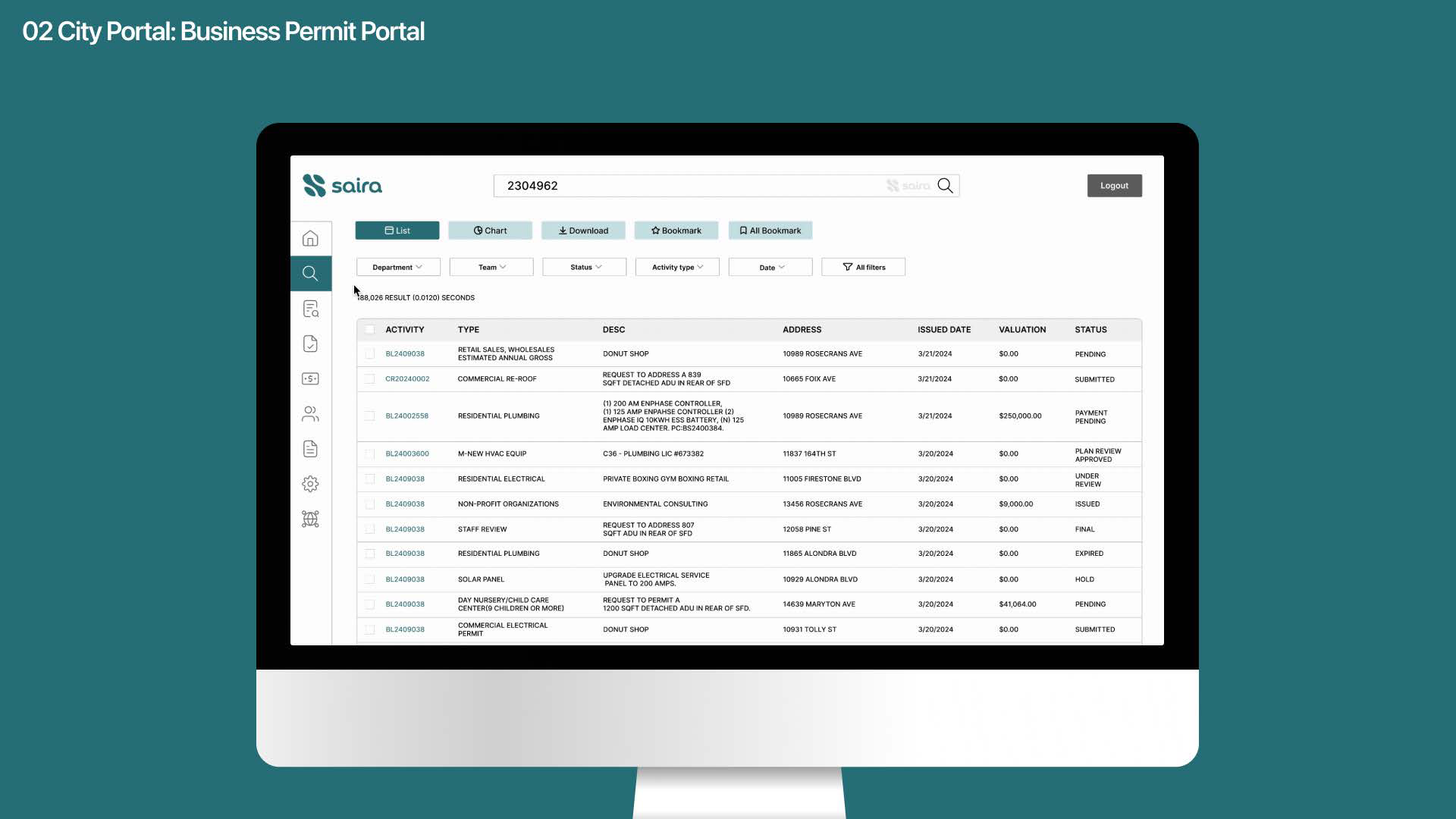
Saira builds permit software for cities, and Norwalk hired us to improve their permit and inspection portal.
Easier for whom, and in what way?
I owned the process end to end. With no researcher on the team, I ran the interviews and the testing alongside the PM.
One constraint ruled every decision: shippable over ideal.
Find the right permit fast, regardless of experience level.
One filter system that scales across every municipality.
02 · Research → Findings
Interviews revealed something more specific than “hard to use.”
Three unknowns drove the research: how many permits move through a day and in what order, whether the problem was the filters or the structure behind them, and whether we were designing for Norwalk or for every Saira municipality. Five interviews and three rounds of usability testing answered them.
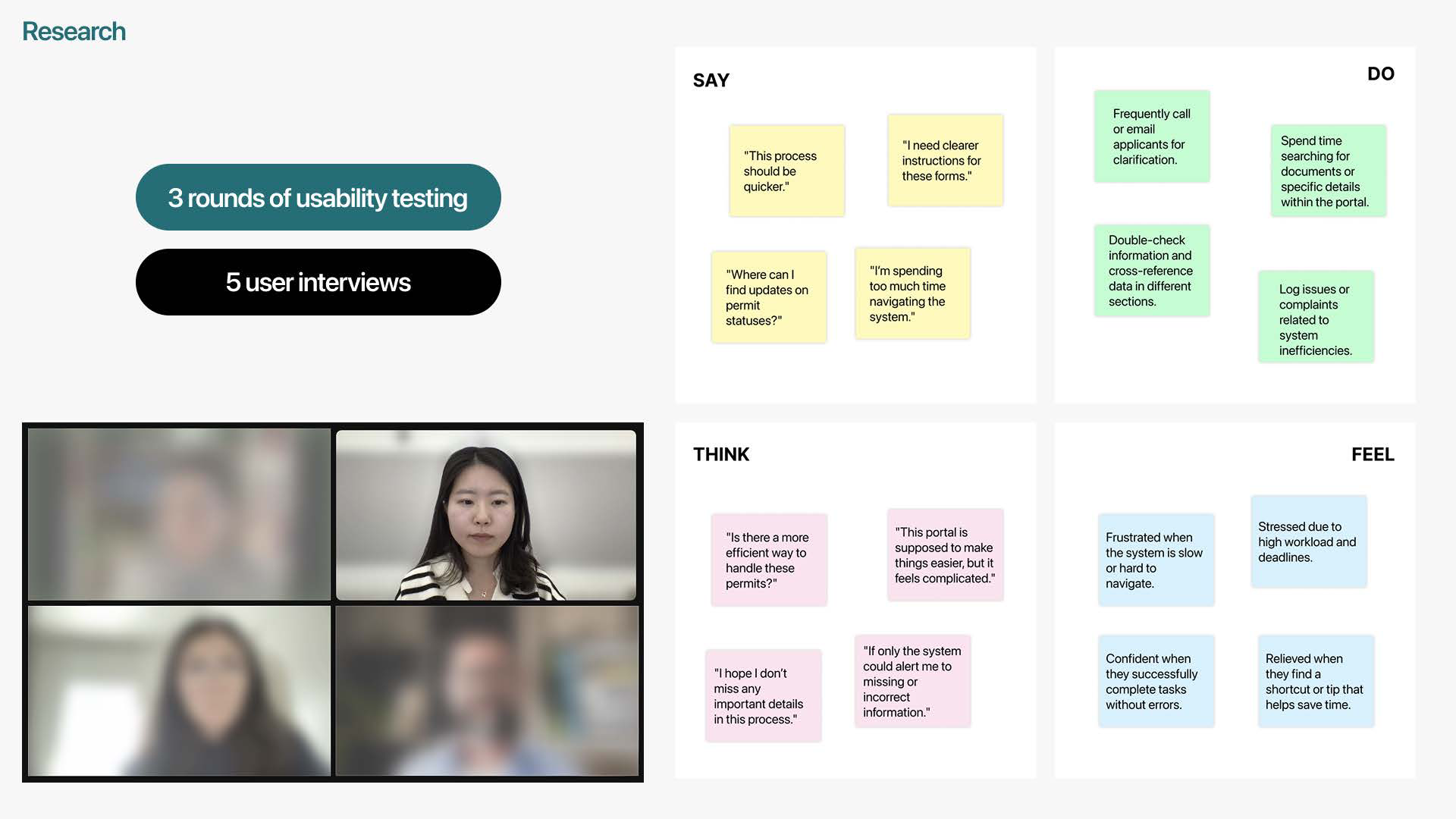
“Every morning, I lose 20 minutes just figuring out what needs attention, bouncing between status and deadline the whole time.”
Jobs-to-be-done made the target concrete. Officers didn't need to track permits. They needed confidence under pressure, which shifted the goal from faster to lower cognitive load.
03 · Challenge 1 · Filter placement
Where filters live wasn't just a UX call.
Filter placement shaped how officers scanned the table daily. I evaluated four options for usability, discoverability, and scalability, then aligned the team.
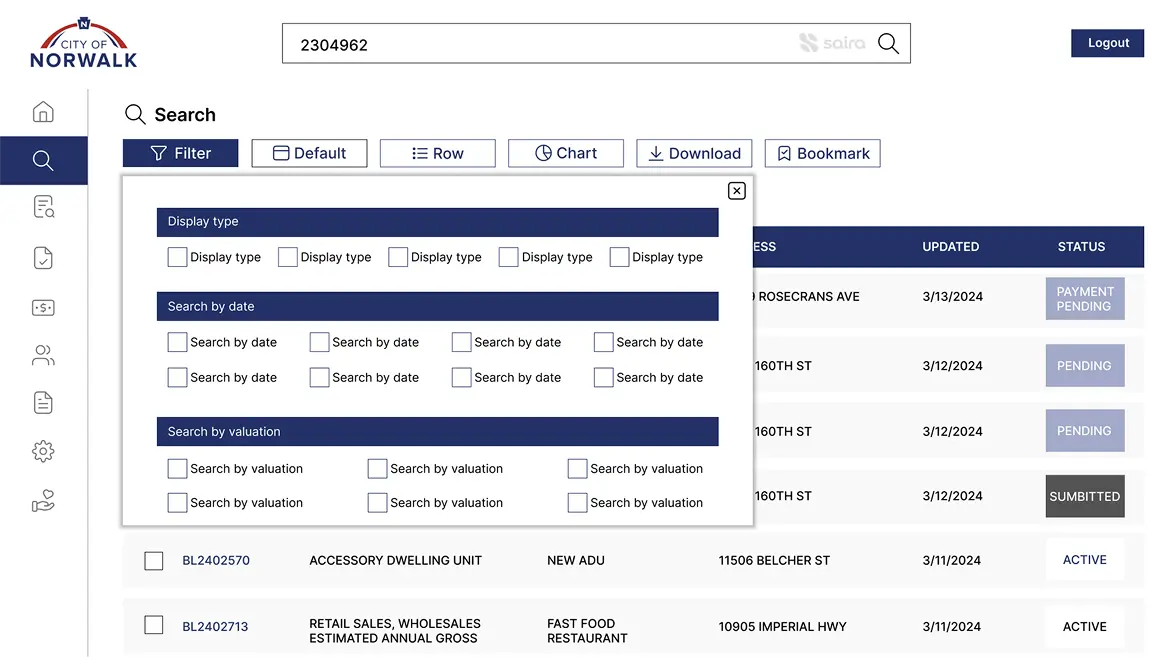
One extra click to open the drawer. Worth it for what it solved.
04 · Challenge 2 · Filter structure
Norwalk's needs couldn't be Norwalk-only.
Every city configures different fields, so the structure had to absorb new filters without a redesign. I tested four patterns — including three accordion passes — against click cost, scannability, and scale.
Each filter is an independent component the drawer can absorb or expose, so a new city changes configuration, not structure.
05 · Final design
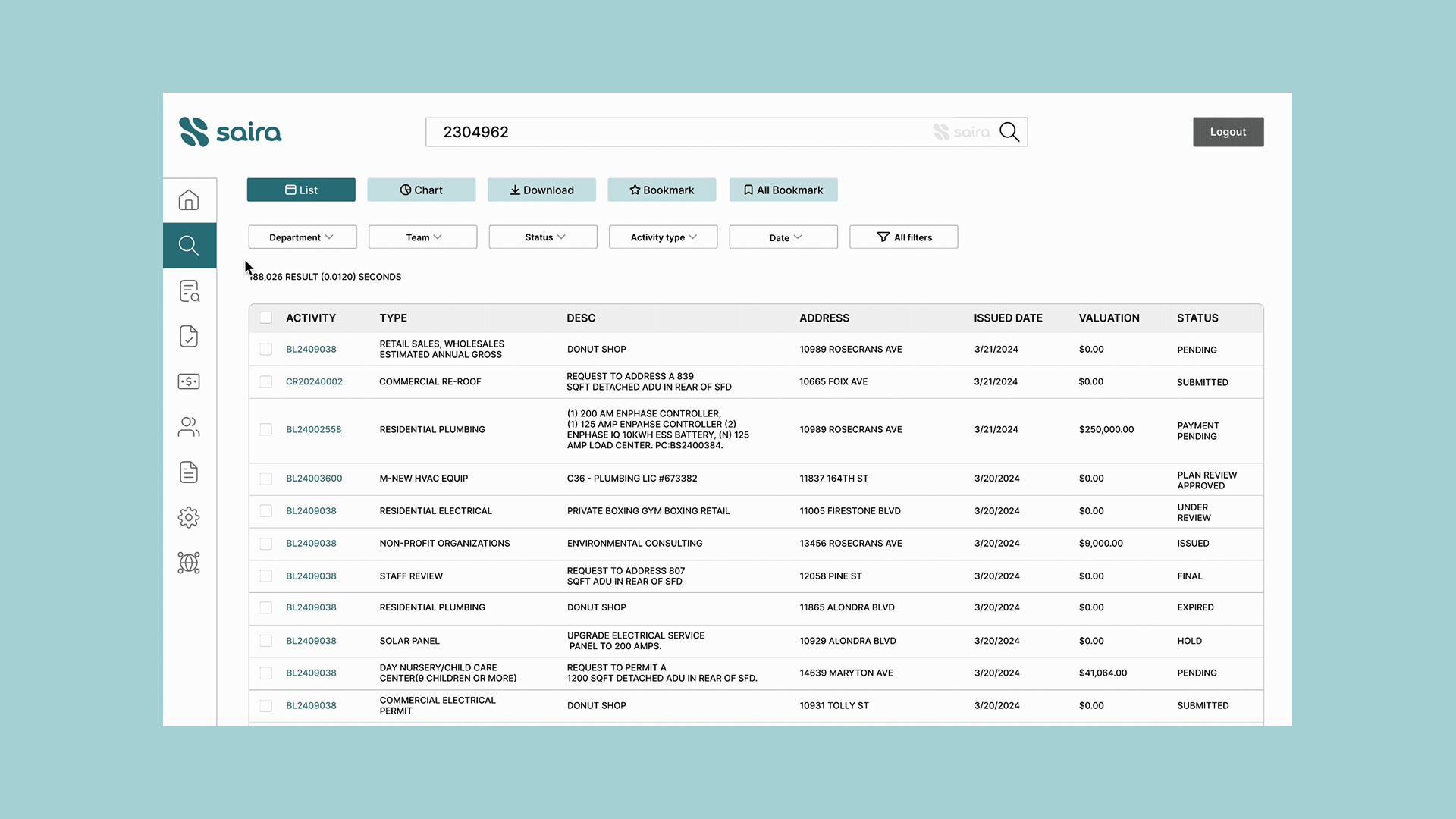
Five common filters up front. Everything else on demand.
Drag the handle to compare. The original panel was organized around database fields, not task priority.
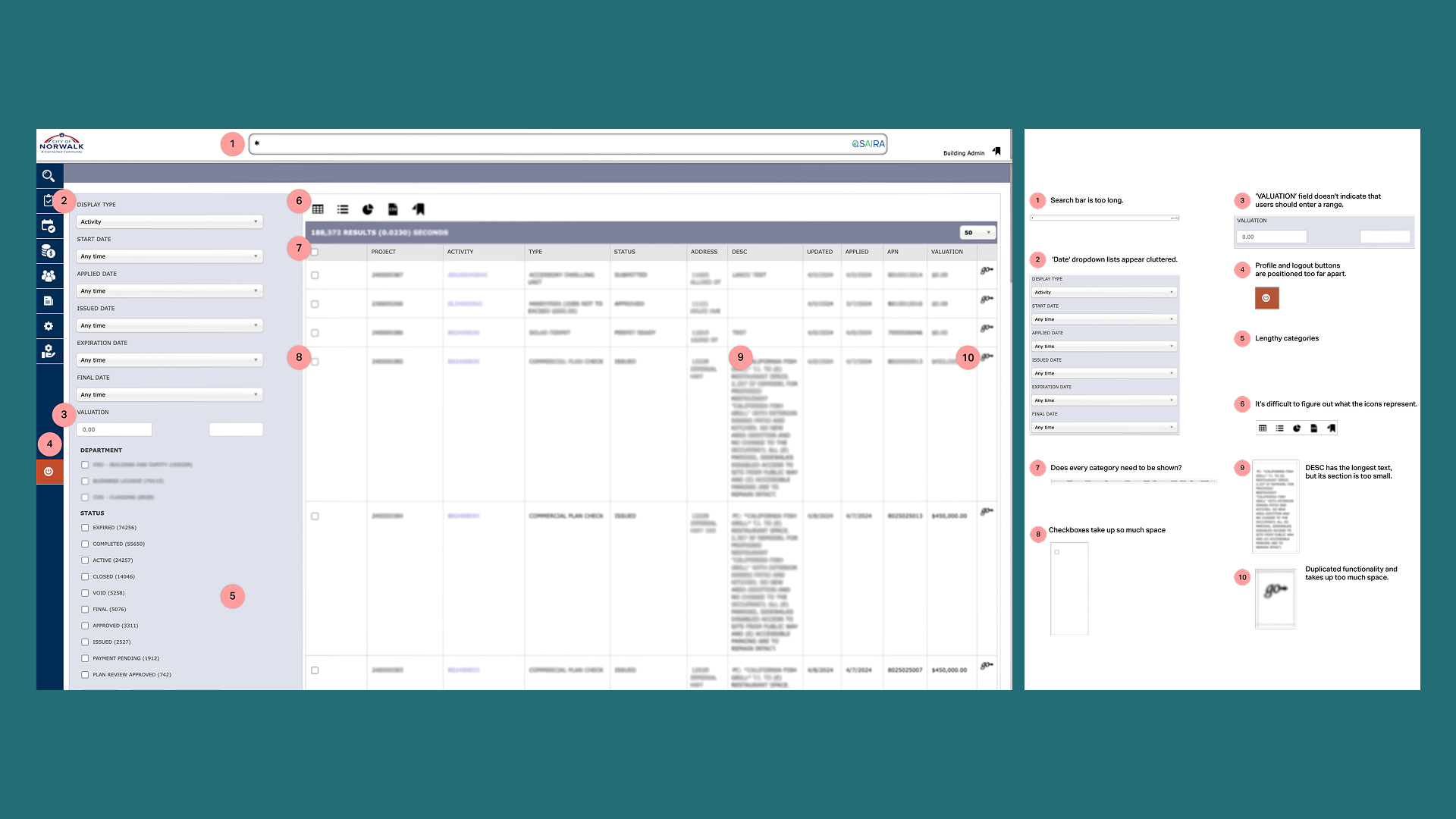
06 · Design system
Built mid-rebrand: a teal palette with measured contrast, and the filter states engineering needed to build from.
The five upfront filters from Challenge 2, specified in every state so engineering could build without asking.
Inter
The selected-filter green only clears AA with ink text, never with white. It is documented rather than hidden, because clarity affects accuracy for officers working under pressure.
07 · Outcome
Measured before and after with the same five officers, across three inspection scenarios.
“This update saves me so much time compared to the old version.”
 Norwalk city officer, 43
“I wish we'd started with this version. It's so much better.”
 Norwalk city officer, 52
08 · Lesson learned
What holds up when the problem's undefined and priorities conflict?
Not one right answer. A structure that can absorb the next one. When the brief is still forming, the durable move is to design for revision: make the trade-offs explicit, keep the parts loosely joined, and leave the reasoning visible for whoever inherits the work.